TDK-Lambda Americas Blog
How N+1 Redundancy ORing Modules Have Evolved
Tuesday, March 31, 2026
The Challenge of Power Supply Redundancy
In any mission-critical system, a single power supply failure can bring operations to a halt. To mitigate this risk, two or more power supplies can be connected in parallel in an N+1 redundant configuration. Should one unit fail, the remaining supply or supplies continue to power the system uninterrupted.
Discrete Diodes: The Starting Point
The earliest solution was to place a discrete diode in series with each power supply output. A shorted supply would then be isolated from the bus, allowing the healthy unit to carry the load. Initially, only Silicon P-N junction diodes were available, which introduced a forward voltage drop of 0.6–0.7V — a penalty in efficiency. The power supply output voltages must be adjusted higher to compensate for the diode drop.
The introduction of Schottky diodes offered a significant improvement, reducing the voltage drop to approximately 0.3–0.4V the losses remained a concern in high-current applications, and engineers continued to seek more efficient alternatives.
MOSFET-Based ORing: A Step Change in Performance
The transition from diodes to MOSFET-based ORing technology represented a fundamental shift. MOSFETs operating in the forward conduction region exhibit very low on-resistance, dramatically reducing voltage drop and power dissipation compared to any diode solution.
TDK-Lambda DLPU/E Redundancy Module
TDK-Lambda took an early step in this direction in 2004 with the launch of the DLPU/E Redundancy Module (Figure 1). This unit incorporated internal ORing diodes, parallel capability, and monitoring signals — combining redundancy protection with system-level visibility in a single package.
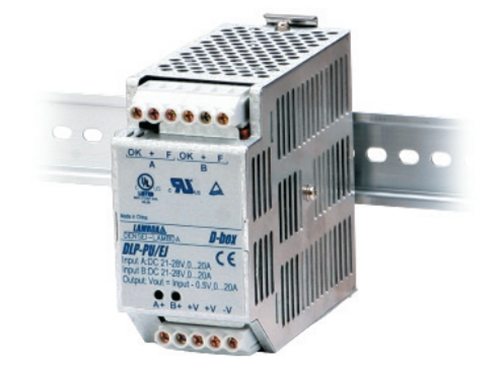
Figure 1: DLPU/E redundancy module
DRM40 Redundancy Module
Building on this foundation, the DRM40 redundancy module (Figure 2) advanced the technology further by replacing diodes with low-loss MOSFETs. The result was an internal voltage drop of just 200mV and power losses of only 8W at 40A — a substantial improvement over diode-based solutions.
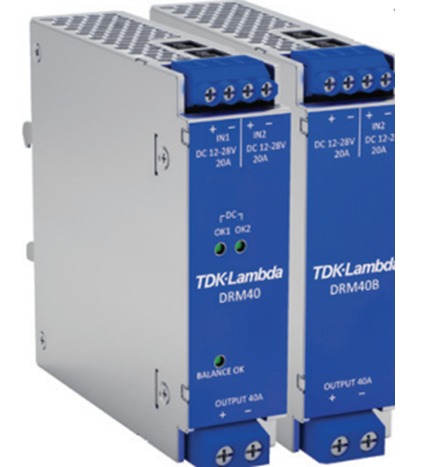
Figure 2: DRM40 redundancy module
RP 60-20 Chassis Mount Module
Designed specifically for industrial applications, the TDK-Lambda RP 60-20 Series (Figure 3) is a chassis-mount reverse current protection module rated at 20A. Maintaining the same 200mV internal voltage drop as the DRM40, the RP 60-20 further reduces reverse current leakage to just 50µA for reliable DC input power.
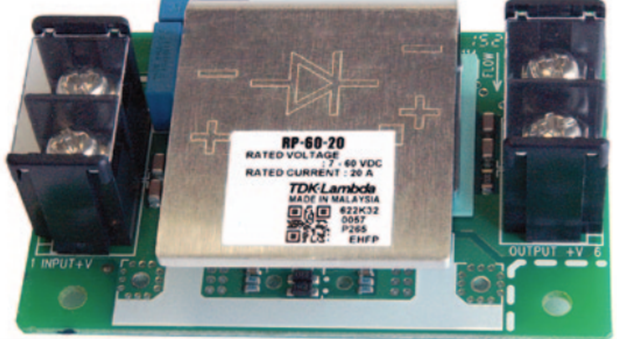
Figure 3: RP 60-20
Meeting the Demands of High-Power Density Systems
The rapid advancement of DC-DC converter technology has dramatically increased power densities, placing new demands on ORing solutions. A prime example is the TDK-Lambda i7A non-isolated DC-DC converter (Figure 4), which delivers up to 1,000W of output power from a compact 34 × 36.8 × 19.8mm board-mount package. As converters like these push current levels ever higher, the ORing module must keep pace.
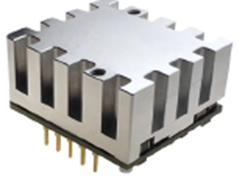
Figure 4: i7A 1,000W DC-DC converter
The i1R ORing Module: High Current, High Efficiency
The TDK-Lambda i1R ORing FET module (Figure 5) has been developed specifically to address the demands of next-generation, high-power systems. Available in 60A and 80A ratings, and with a maximum input voltage of 60Vdc, the i1R replaces traditional diodes in applications requiring ORing functionality for power supply redundancy or parallel operation.
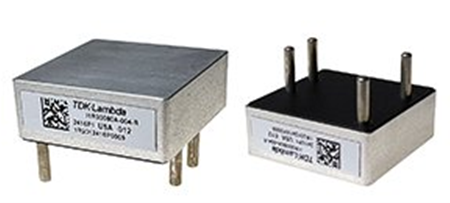
Figure 5: i1R ORing modules — 99.5% efficient
Key Performance Attributes
Speed: The i1R features a fast 500ns (typical) turn-off response, rapidly blocking reverse current transients during fault conditions. This swift response minimizes the impact of a supply failure on the load, providing a higher degree of system protection than slower, diode-based alternatives.
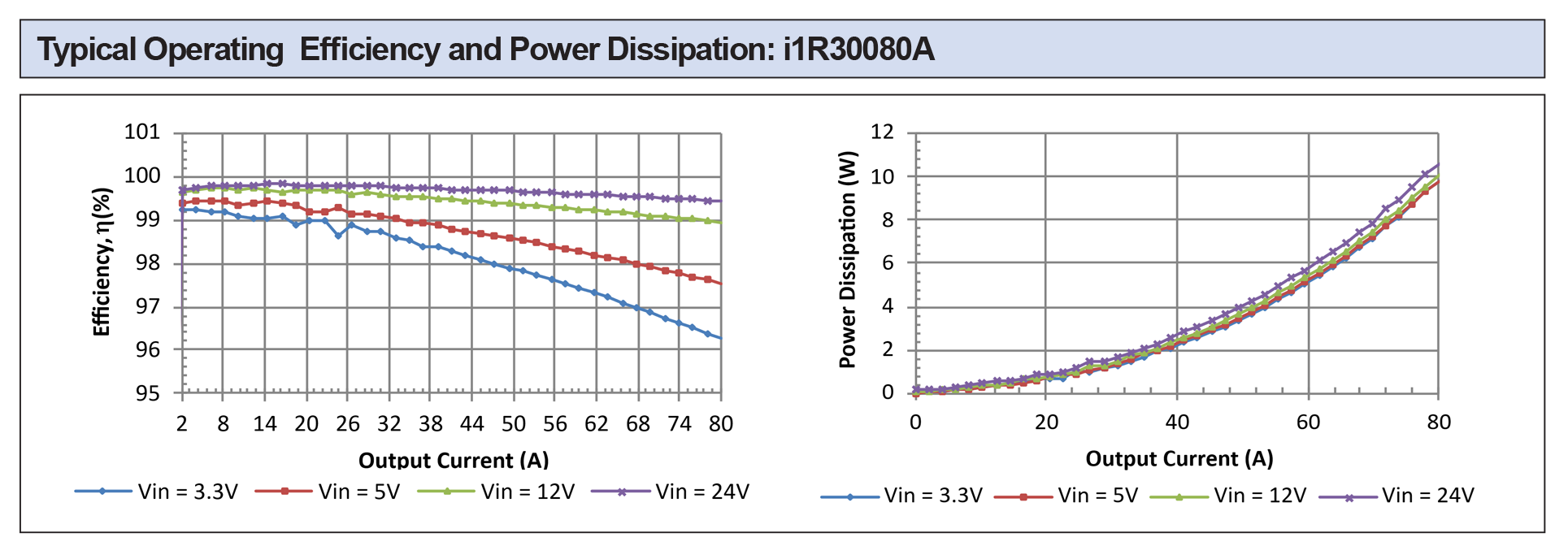
Efficiency: With a typical on-resistance of just 2.5mΩ (60A version) and 1.5mΩ (80A version), power losses are kept to an absolute minimum. At full 80A load, total power dissipation is just 10W (see below) contributing to a 99.5% efficiency rating. This not only reduces wasted energy but also simplifies the thermal design.
Ruggedness: Housed in a compact and robust package, the i1R series is engineered for harsh environments. With high resistance to shock and vibration, these modules are well-suited to demanding industrial applications and robotics, where reliability under mechanical stress is as important as electrical performance.
Summary
From Silicon P-N diodes to state-of-the-art MOSFET ORing modules, the technology underpinning N+1 redundancy has advanced considerably. Each generation has delivered lower losses, faster response times, and greater reliability. The i1R offers system designers a compact, highly efficient ORing solution capable of supporting the highest power densities available in today's market.
For more information on how the i1R and other TDK-Lambda power modules can help minimize the size and maximize the reliability of your next design, please contact our technical support team.